
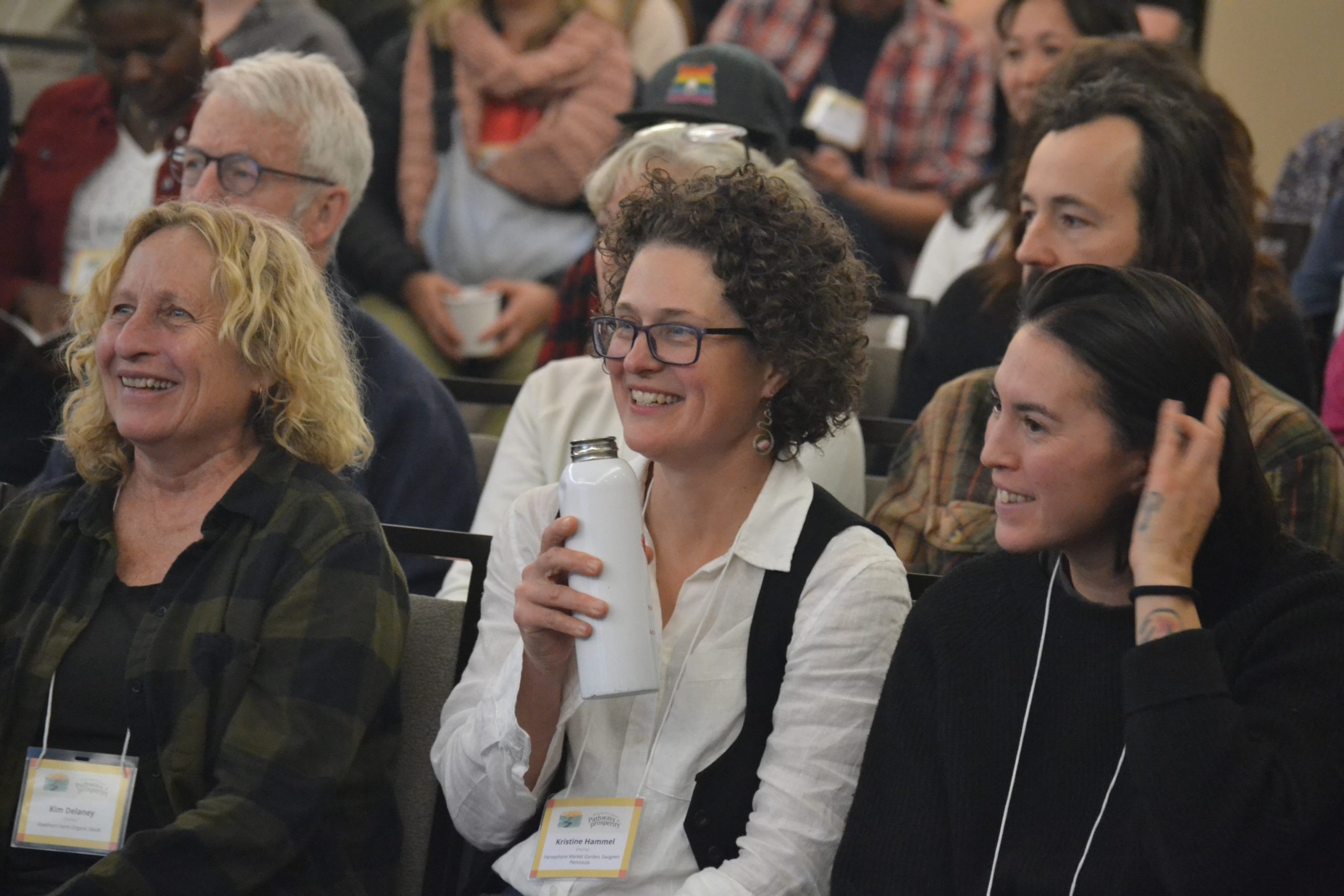
Kristine and Meghan share a laugh with Kim Delaney during the Mulchapalooza session
At EFAO’s annual conference last December, EFAO members and farmer-researchers Kristine Hammel, Nathan Klassen and Meghan Robbins spoke at the session titled Mulchapalooza—a masterclass in the practice of utilizing mulches on the farm.
Nathan, Kristine and Meghan shared their tips and observations from integrating mulch into vegetable, flower and seed productions, and Nathan and Meghan discussed their experiences participating in the Living Lab – Ontario trials for growing winter squash and potatoes with mulch. After this popular session, we wanted to follow up with them and share more of their thoughts, insights and experiences incorporating mulch on their farms.
EFAO: What were the core reasons you decided to trial mulching on your farm?
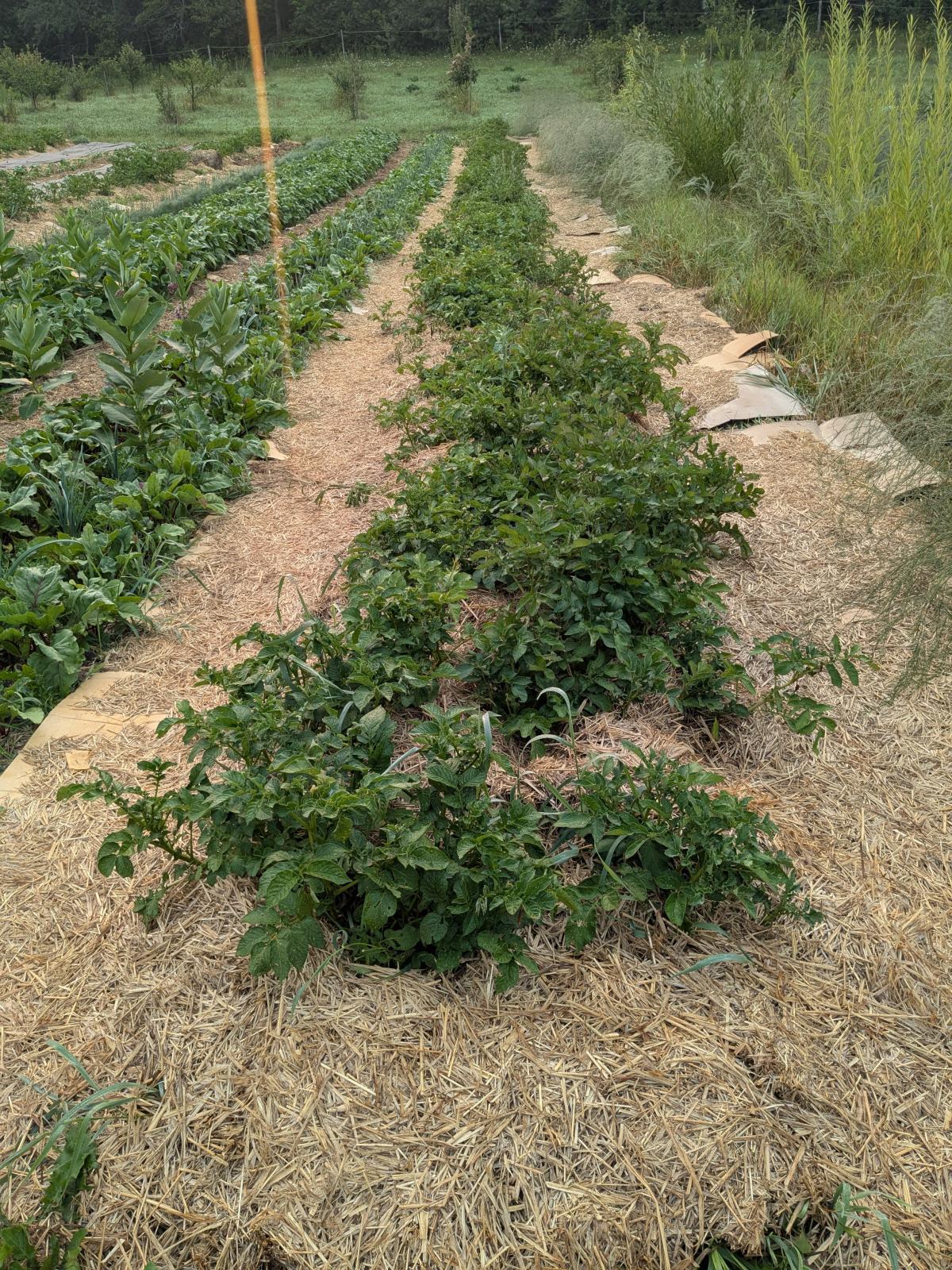
Mulched potatoes at Kristine’s farm
Kristine: Desperation! I was short-staffed after having a baby in May 2012, which really provided motivation to try mulching to manage weeds that year. A one-time application of mulch versus weekly weeding? That sure sounded good! That season also turned into a very dry summer and made obvious another very good reason to mulch: to preserve soil moisture. After the first trial season, I was convinced of the benefits of mulching for weeds and soil moisture. Every season since then has provided confirmation for these findings.
Nathan: Soil improvement. We had one area that we could grow profitably on and another area that was, on net, subtracting from those overall profits. Cover cropping wasn’t making the necessary difference, but we were seeing initial positive results from mulching and that made us decide to trial squash on mulch. One of the biggest features of this squash crop area in our system is that it can take larger amounts of land, increasing the impact we can achieve through mulching.
Meghan: In late 2024 at the EFAO conference, I heard about the FLR trials for the first time and learned there was an ongoing no-till potato trial. In 2025, I decided to join this trial, and subsequently have become more interested in mulch and no till practices since my participation. The initial goal to use mulch and participate in this trial was to find another way to produce potatoes while minimizing our soil microbial disturbance. I am responsible for mixed vegetable production at the farm, so being able to align our farm’s mission, increase the variety of products available to our community, and collect and share information with other farmers seemed exciting.
 EFAO: Briefly describe your mulching practices (type of mulch, with what crops, etc).
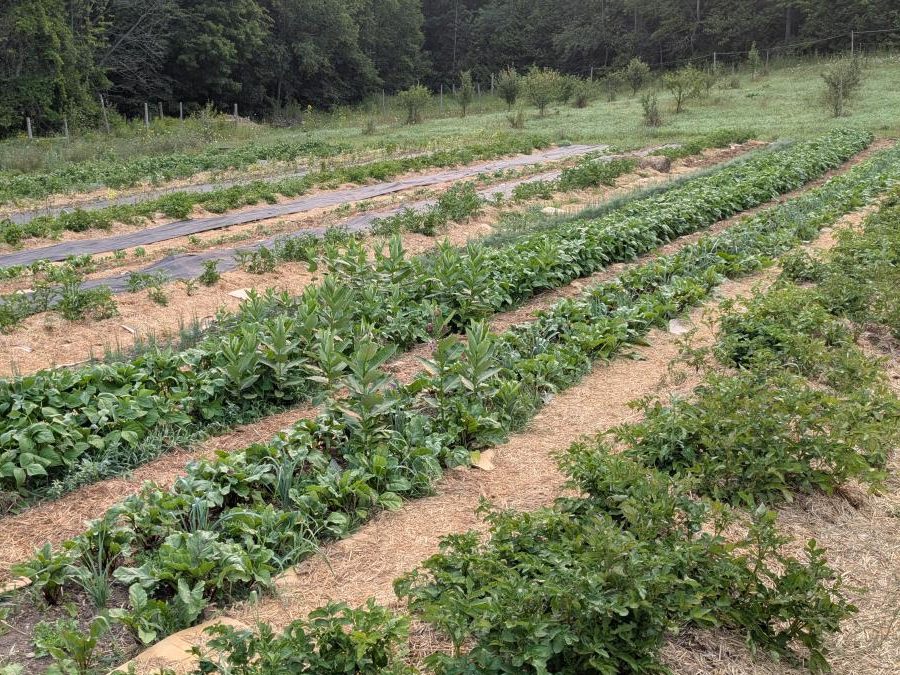
Kristine: I use finely chopped switchgrass straw at three to four inches on peppers, onions, leek, chard & kale (for repeat, full-size leaf harvest), potatoes, celery & celeriac, parsley, basil and cardboard topped with switchgrass straw on paths and on tomato beds.
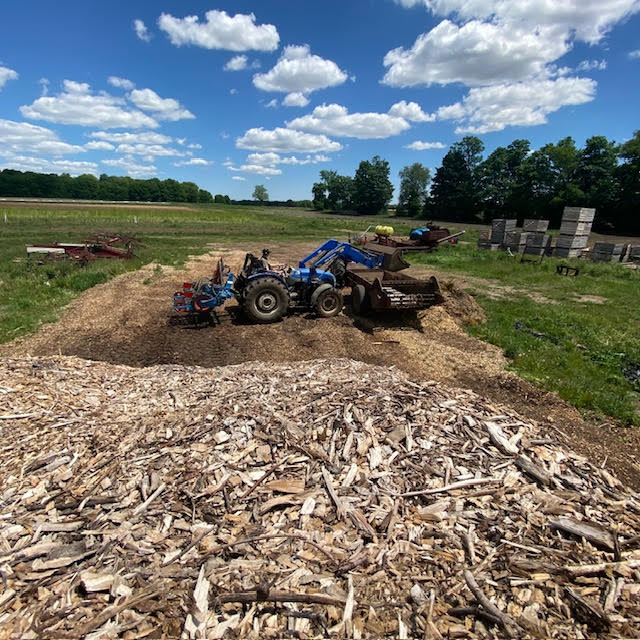
Nathan moving woodchips at his farm
Nathan: We mulch with wood chips. There are two reasons for this choice of material. First, we have a relationship with a tree service company, so the chips are free and abundant. This also means the chips are mixed-species and we can’t be picky with the type or quality of chips — we use it all! Second, they work well with our equipment. We apply everything with a manure spreader because it works well with our scale.
Key to the success of wood mulch is adding enough fertility to the soil to compensate for the nitrogen penalty. We start with a layer of manure or compost, prepare the seedbed as usual, and then apply about three to four inches of chips on top. In the case of garlic, we plant into the prepared soil before mulching. With squash, we clear a furrow after mulching to direct seed into the mulched soil with three to four inches of mulch. We also mulch our asparagus. There is no bed prep stage at this point, just seasonal applications of compost followed by three to four inches depth of wood chips.
Meghan: I chose (up to) six inch straw mulch for our no-till potato trial because it is a material that is widely available and commonly used in no-till practices. We had it (and usually have it) on hand at the farm so it is easily replicable in the future. I also wanted something that would break down quickly over time.
EFAO: What do you think is the important thing people need to know about integrating mulching/no-till practices into their farm? What are important lessons you have learned? When does mulching work and not work?
Kristine: There is no cookie-cutter solution. Instead, it’s all about working with one’s context and farm. Key considerations include:
- What mulch material is available where you are, in appropriate quantity, quality and price?
- At what scale do you operate and what options does that create for applying mulch?
- How will mulch residue interact with tools and how will this affect you?
For example, as we increased use of straw mulch, we decreased use of wheel hoes. They weren’t needed or they weren’t as effective, in the presence of mulch residue. This had secondary implications for row cover use because we had used a plow attachment on our wheel hoes to create a trough, lay the edge of the row cover in this trough, and then use the wheel hoe to dump soil onto the row cover edge. This method no longer works and we have switched to landscape staples. If anyone is looking for a couple of wheel hoes, I have some for sale!
- Mulch can address many challenges: weeds, soil moisture (infiltration and retention), vibrancy of soil life and nutrient cycling, pest and disease issues.
- It might also create a couple of new challenges. Hello, voles and slugs!
At this point, though, I would rather deal with addressing any issues associated with mulching, rather than giving up on mulch.
Nathan: When this system works, it is very individual. For us, mulching works well for squash, but when we tried with tomatoes it was a disaster. These results don’t match others’ experience, but it is what works for us in our unique circumstances.
Fertility is key with our type of system. Soils want to return to a specific carbon-to-nitrogen ratio, so in order to match a heavy carbon application, we need nitrogen to keep that balance and feed the soil for the years to come.
Mulch will also change which weeds you are dealing with. Tough perennial weeds may get established during the lower tillage period when there is less competition from the normal annual weeds. We have had to change weed management strategies in order to address thistle, grass, and even some woody species that got their start from the chips themselves.
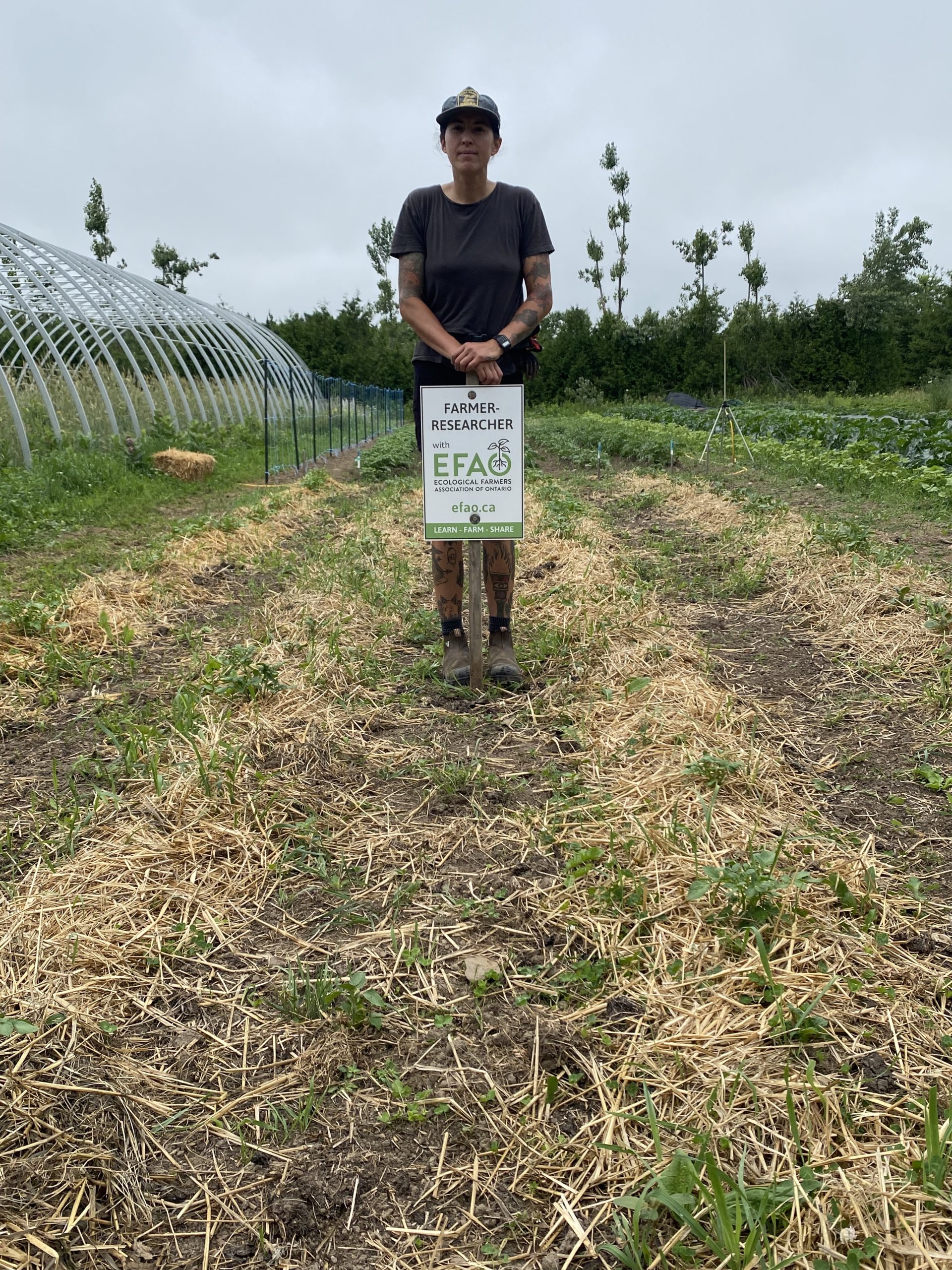
Megan in the trial plot at the New Farm Centre
Meghan: I was surprised by the potato yields achieved with the no-till straw mulching method, having not planted potatoes this way before. Though we saw good yields across the four varieties trialled, it was not without its faults. The main issue with using this method was getting the depth of the straw adjusted correctly. I should have bulked up the depth of the mulch either initially or during the season at least once. Not having good depth and compaction issues contributed to too much light getting through, affecting a couple of the varieties’ yields.
There are multiple benefits to using mulching practices, some of which I was beginning to see, and others I believe I will continue to, moving forward. The most basic observation is that you CAN successfully grow vegetables in mulch without disturbing your soil in a harsh way. Through the stories and information shared by Nathan and Kristine during the Mulchapalooza session, you can see the long-term benefits with improved soil structure and in some anecdotes, increased yields.
EFAO: What questions do you still have about mulch? What observations do you have that leave unanswered questions? Do you have future trials you’d like to design or take part in? Or what are you trying to refine in your mulching practices?
Kristine: I am working on managing slugs using poultry (chickens and ducks) at the end of the growing season. I am also looking for ideas for vole management.
Nathan: I would like to further explore what I can do with other crops, especially cool season crops, like broccoli and cabbage. Also I want to explore finding ways to make grown-in-place mulches work for me. Right now, within the mulch system I have, I am working on what it takes to shorten the post mulch re-crop time. Currently we give the following spring off from cropping and sow again in late July for fall crops. I think with time as our soils get better at digesting chips this can be shortened substantially.
Meghan: Aside from the farmer-led research no-till potato trials, we are in discussion about other areas around the farm where we can incorporate mulch in a more meaningful way. I will likely participate in the no-till squash trials in the future, as Nathan provided great information and stats on his mulching practices regarding squash and woodchips. There were also great stories shared about mulching practices and asparagus productivity; an earlier crop on our farm that we could potentially use these practices to resurrect back into our regular rotation.
For market garden farms, homesteads, those with mobility limitations, or starting soil restructuring projects, no-till and mulching practices can be something to consider shifting towards. Every person’s farm is different, so figuring out which mulch method best suits you can take a minute. Consider your long-term budget, labour intensity, space, or even the rate of change you’re comfortable with. Incorporating a new or different method can have challenging moments, but we’re not ecological farmers for nothing.
—
If you want to learn more about the no-till potato and squash trials please visit https://efao.ca/farmer-led-research/ to explore some of the past farmer-led research trials on this topic. To learn more about Living Labs, visit: https://efao.ca/living-lab/
Meghan, Nathan, and Kristine will be hosting Field Days at their farms and sharing more on their no-till trial work this season. Please visit efao.ca/events and stay tuned to the e-newsletter for event listings.
Result summaries from the no-till mulching trials will be available this spring. Recordings of the 2025 Research Symposium will be available on the EFAO Member Video Library soon.
Kristine Hammel just completed her 16th season of market gardening on the Saugeen Peninsula. She grows veg and herbs for a small, 20-week CSA; veg, herb, annual and native perennial flowers for seed on contract with small, bioreginal seed companies, and a whole bunch of basket willow. Together with her husband, she stewards 100 acres while raising 3 kids.
Nathan Klassen, along with his wife Aleta, runs Nith Valley Organics, an Ecological Mixed farm including a 6 acre market garden, sheep, chickens, turkeys, and ducks. Nathan has been experimenting with reduced tillage mulch culture for the past eight years as a way to reduce weeding, retain moisture, and build soil health. He calls himself a reluctant permaculturalist, preferring to manage mulch at a mechanized scale. Nathan graduated with a degree in Organic Agriculture from University of Guelph in 2010 and started Nith Valley Organics in 2011.
Meghan Robbins is currently coordinating the vegetable gardens at The New Farm Centre, a certified Regenerative-Organic Farm in Creemore, Ontario (located on the traditional lands of the Anishinabek, Huron-Wendat, Mississauga, and Tionontati (Petun) peoples). After nearly two decades of being a Chef in the Culinary Industry, Meghan made the move to vegetable growing in 2021. It was their interest in food security, diversity, community, regenerative agriculture and the attraction to knowledge sharing that helped drive the change. Meghan is pleased to be a part of a farm where they can get their hands dirty; enhancing their skills with like-minded people working towards brighter possibilities and a more climate sustainable food culture.
—
Funding for this project has been provided by Agriculture and Agri-Food Canada under the Agricultural Climate Solutions – Living Labs program and by the following partners: Beef Farmers of Ontario, Dairy Farmers of Ontario, Grain Farmers of Ontario, Ontario Federation of Agriculture, Ontario Pork and Ontario Sheep Farmers. The project is coordinated by the Ontario Soil and Crop Improvement Association.