
Congratulations to our winner, Michelle Della Corte from Fungi Fest Mtl.

Every year, the Carrot Cache Innovation Prize highlights practical, low-cost ideas that farmers are already using in planting, harvesting, and managing food grown on their organic farms to build financial and environmental sustainability.

Thank you to all those who submitted their innovations, to all the conference participants who voted, and thank you to The Carrot Cache for offering this prize! The Carrot Cache is a small foundation that funds co-operatives, local organic food initiatives and community food strategies in Ontario.

——————————————————————

Below is the original contest submission by Michelle:

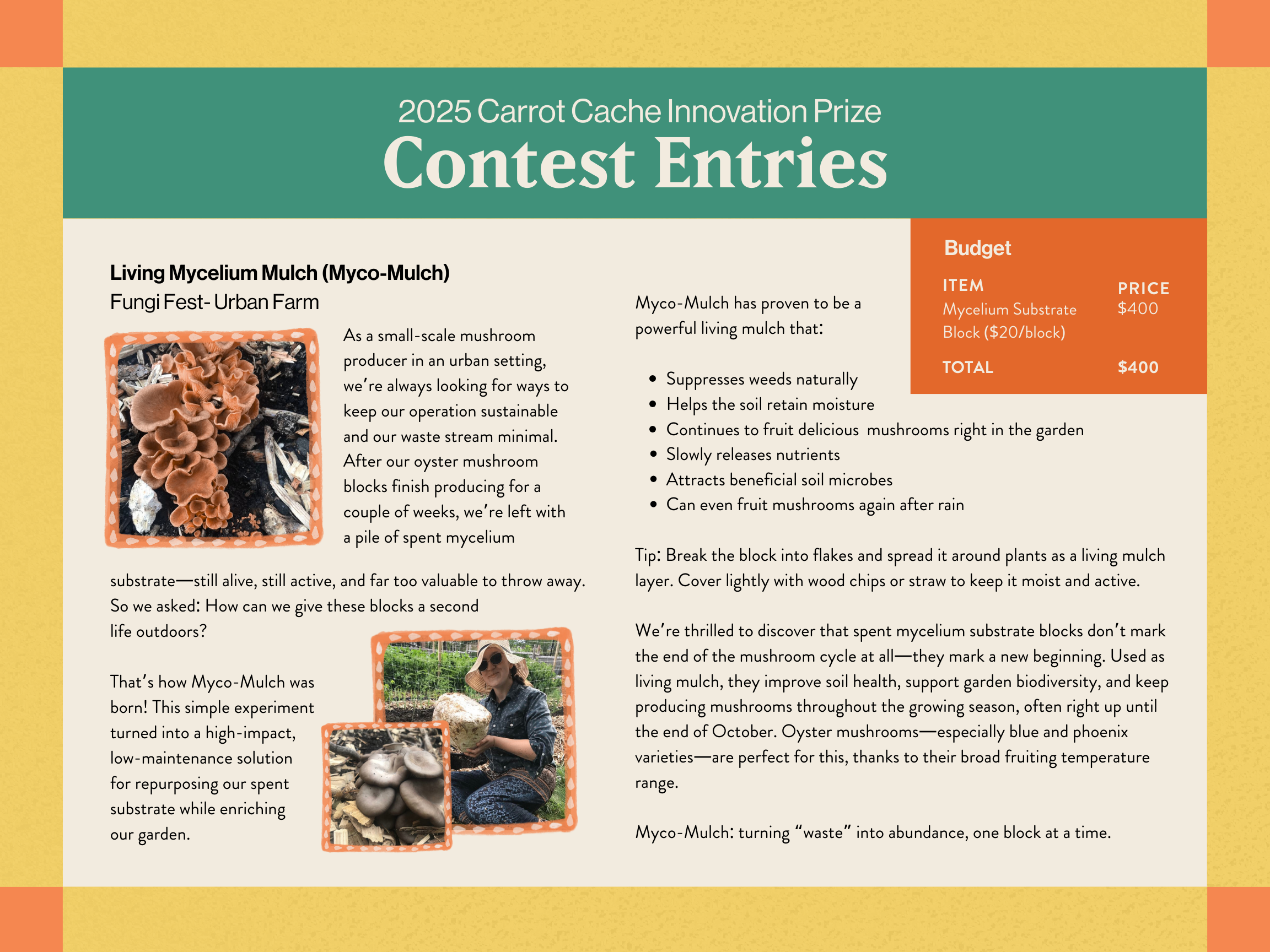
As a small-scale mushroom producer in an urban setting, we’re always looking for ways to keep our operation sustainable and our waste stream minimal. After our oyster mushroom blocks finish producing for a couple of weeks, we’re left with a pile of spent mycelium substrate—still alive, still active, and far too valuable to throw away. So we asked: How can we give these blocks a second life outdoors?

That’s how Myco-Mulch was born! This simple experiment turned into a high-impact, low-maintenance solution for repurposing our spent substrate while enriching our garden.

Myco-Mulch has proven to be a powerful living mulch that:

  • Suppresses weeds naturally
  • Helps the soil retain moisture
  • Continues to fruit delicious mushrooms right in the garden
  • Slowly releases nutrients
  • Attracts beneficial soil microbes
  • Can even fruit mushrooms again after rain

Tip: Break the block into flakes and spread it around plants as a living mulch layer. Cover lightly with wood chips or straw to keep it moist and active.

We’re thrilled to discover that spent mycelium substrate blocks don’t mark the end of the mushroom cycle at all—they mark a new beginning. Used as living mulch, they improve soil health, support garden biodiversity, and keep producing mushrooms throughout the growing season, often right up until the end of October. Oyster mushrooms—especially blue and phoenix varieties—are perfect for this, thanks to their broad fruiting temperature range.

Myco-Mulch: turning “waste” into abundance, one block at a time.

——————————————————————

To read about all of this year’s fantastic entries, take a look at the Carrot Cache Prize posters below. Please click on a poster to enlarge it.
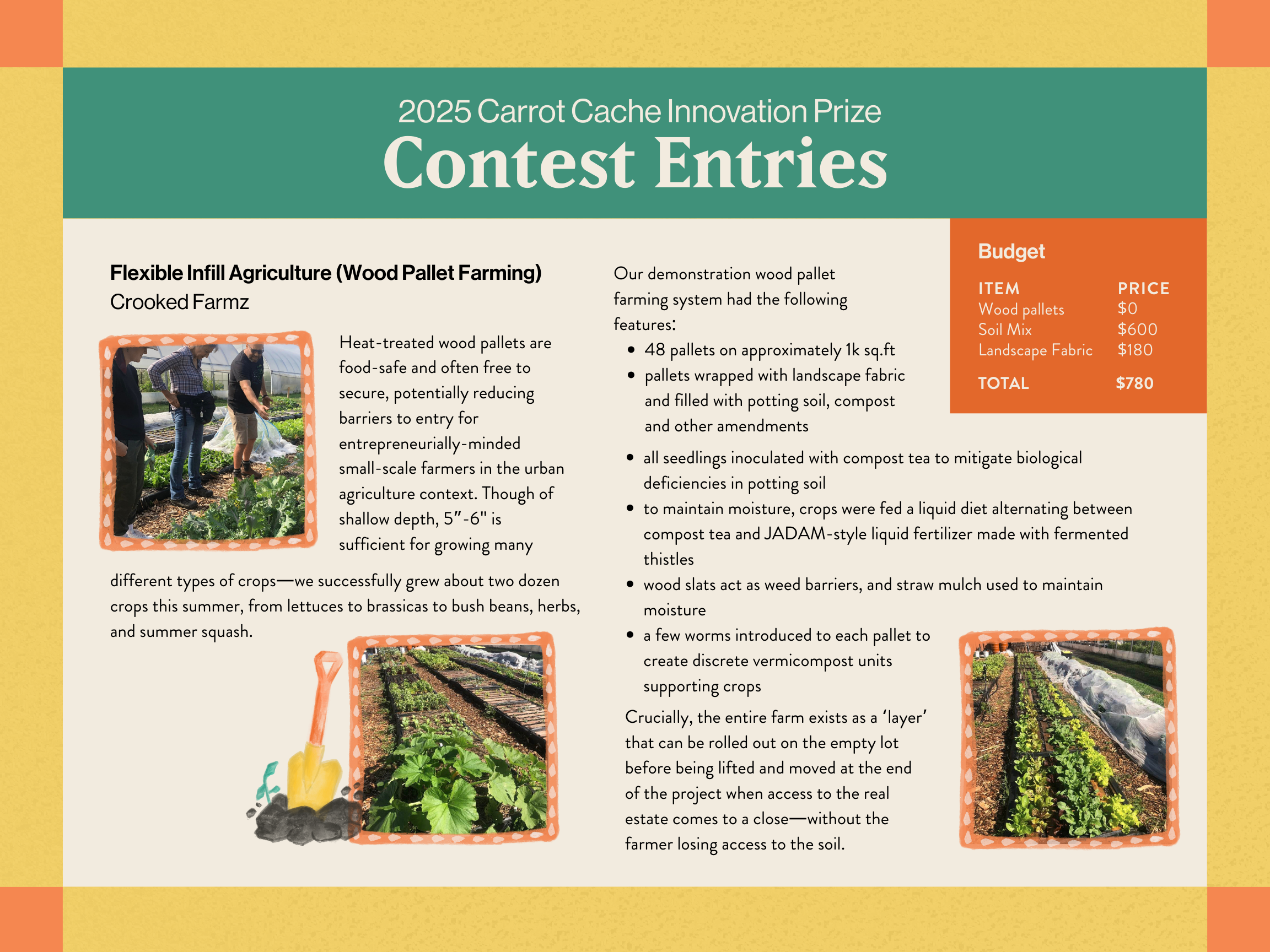
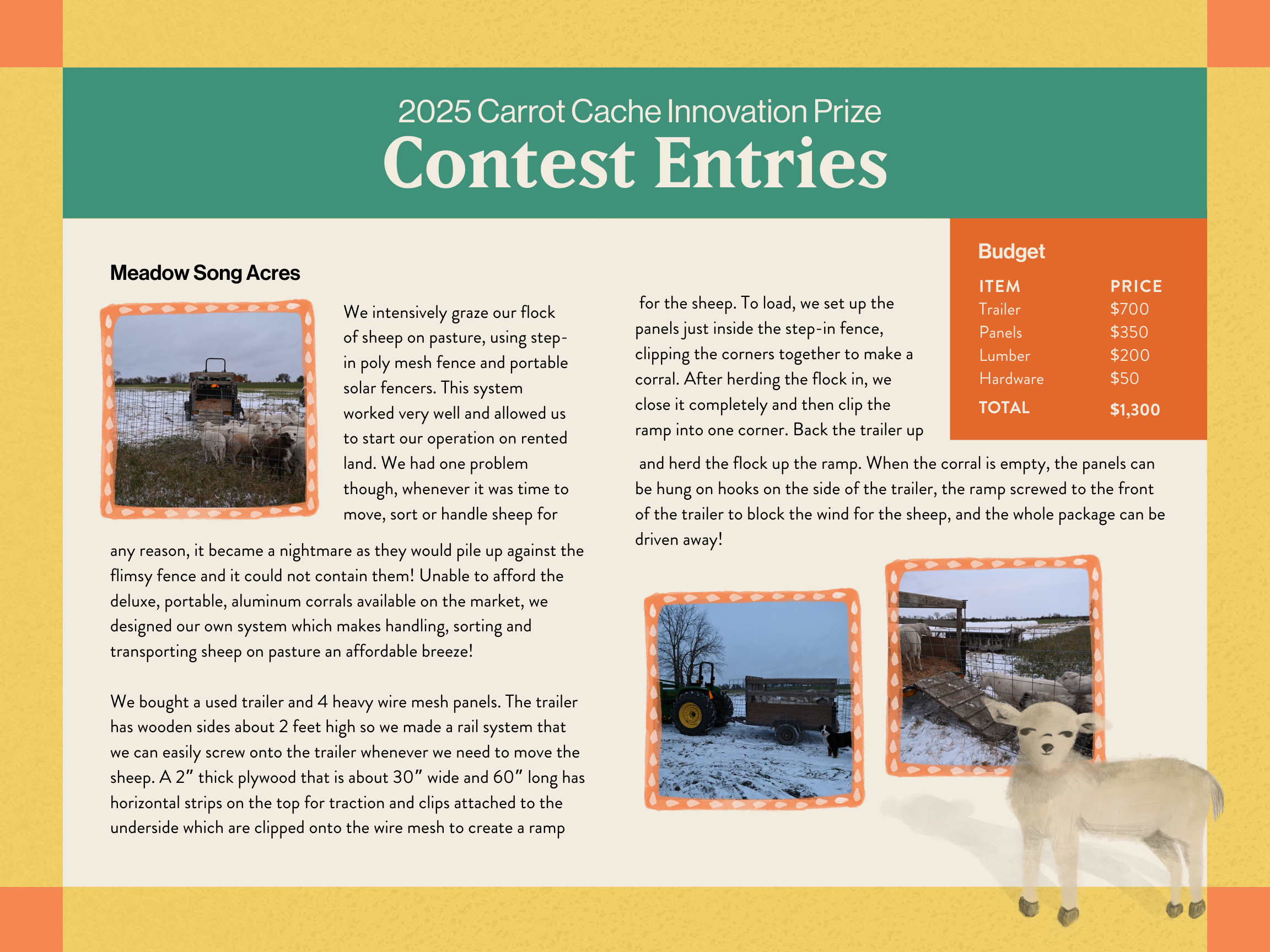
 

Heat-treated wood pallets are food-safe and often free to secure, potentially reducing barriers to entry for entrepreneurially-minded small-scale farmers in the urban agriculture context. Though of shallow depth, 5"-6" is sufficient for growing many different types of crops--we successfully grew about two dozen crops this summer, from lettuces to brassicas to bush beans, herbs, and summer squash. Our demonstration wood pallet farming system had the following features: • 48 pallets on approximately 1k sq.ft • pallets wrapped with landscape fabric and filled with potting soil, compost and other amendments • all seedlings inoculated with compost tea to mitigate biological deficiencies in potting soil • to maintain moisture, crops were fed a liquid diet alternating between compost tea and JADAM-style liquid fertilizer made with fermented thistles • wood slats act as weed barriers, and straw mulch used to maintain moisture • a few worms introduced to each pallet to create discrete vermicompost units supporting crops Crucially, the entire farm exists as a 'layer' that can be rolled out on the empty lot before being lifted and moved at the end of the project when access to the real estate comes to a close--without the farmer losing access to the soil.   We intensively graze our flock of sheep on pasture, using step-in poly mesh fence and portable solar fencers. This system worked very well and allowed us to start our operation on rented land. We had one problem though, whenever it was time to move, sort or handle sheep for any reason, it became a nightmare as they would pile up against the flimsy fence and it could not contain them! Unable to afford the deluxe, portable, aluminum corrals available on the market, we designed our own system which makes handling, sorting and transporting sheep on pasture an affordable breeze! We bought a used trailer and 4 heavy wire mesh panels. The trailer has wooden sides about 2 feet high so we made a rail system that we can easily screw onto the trailer whenever we need to move the sheep. A 2" thick plywood that is about 30" wide and 60" long has horizontal strips on the top for traction and clips attached to the underside which are clipped onto the wire mesh to create a ramp for the sheep. To load, we set up the panels just inside the step-in fence, clipping the corners together to make a corral. After herding the flock in, we close it completely and then clip the ramp into one corner. Back the trailer up and herd the flock up the ramp. When the corral is empty, the panels can be hung on hooks on the side of the trailer, the ramp screwed to the front of the trailer to block the wind for the sheep, and the whole package can be driven away!

As a small-scale mushroom producer in an urban setting, we're always looking for ways to keep our operation sustainable and our waste stream minimal. After our oyster mushroom blocks finish producing for a couple of weeks, we're left with a pile of spent mycelium substrate-still alive, still active, and far too valuable to throw away. So we asked: How can we give these blocks a second life outdoors? That's how Myco-Mulch was born! This simple experiment turned into a high-impact, ow-maintenance solution for repurposing our spent substrate while enriching our garden. Myco-Mulch has proven to be a powerful living mulch that: • Suppresses weeds naturally • Helps the soil retain moisture • Continues to fruit delicious mushrooms right in the garden • Slowly releases nutrients • Attracts beneficial soil microbes • Can even fruit mushrooms again after rain Tip: Break the block into flakes and spread it around plants as a living mulch layer. Cover lightly with wood chips or straw to keep it moist and active. We're thrilled to discover that spent mycelium substrate blocks don't mark the end of the mushroom cycle at all--they mark a new beginning. Used as living mulch, they improve soil health, support garden biodiversity, and keep producing mushrooms throughout the growing season, often right up until the end of October. Oyster mushrooms especially blue and phoenix varieties are perfect for this, thanks to their broad fruiting temperature range. Myco-Mulch: turning "waste" into abundance, one block at a time.   have found that deterring deer from feasting on our zucchini is as simple as transplanting native bergamot or any other monarda related plants at the ends of the rows. These plants grow and fill in very quickly after being transplanted. They, like mint, prefer new environs on a fairly regular basis. The cost is as low as $5 for seed, although best to establish a planting a year in advance. Other benefits include attracting pollinators - especially bumble bees during their long blooming stage. These plants could also be used as cut flowers, but I just left these for the bees this past year. Other highly scented plants may work as well.

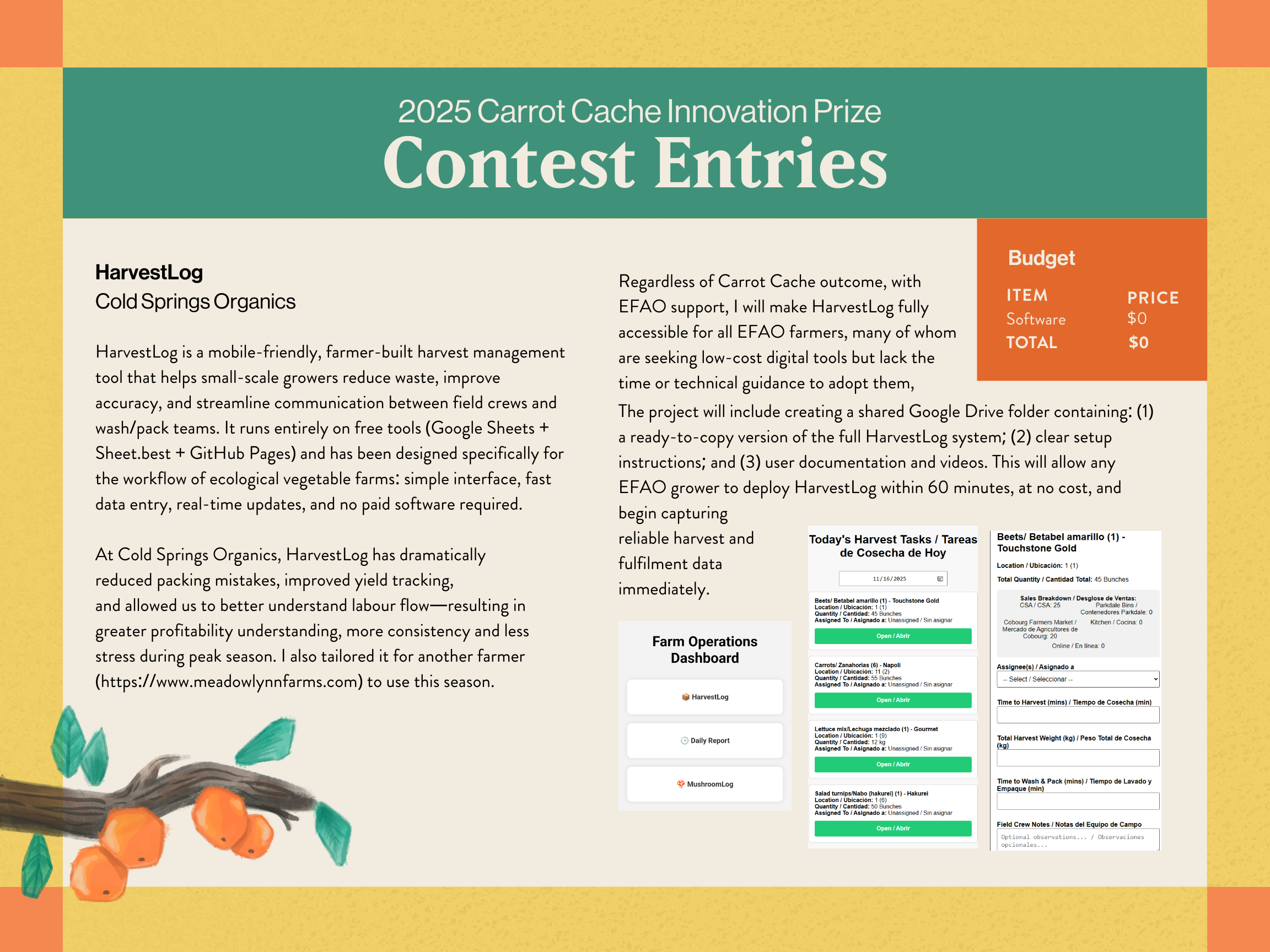
Harvest Log is a mobile-friendly, farmer-built harvest management tool that helps small-scale growers reduce waste, improve accuracy, and streamline communication between field crews and wash/pack teams. It runs entirely on free tools (Google Sheets + Sheet.best + GitHub Pages) and has been designed specifically for the workflow of ecological vegetable farms: simple interface, fast data entry, real-time updates, and no paid software required. At Cold Springs Organics, Harvest Log has dramatically reduced packing mistakes, improved yield tracking, and allowed us to better understand labour flow-resulting in greater profitability understanding, more consistency and less stress during peak season. I also tailored it for another farmer (https://www.meadowlynnfarms.com) to use this season. Regardless of Carrot Cache outcome, with EFAO support, I will make HarvestLog fully accessible for all EFAO farmers, many of whom are seeking low-cost digital tools but lack the time or technical guidance to adopt them, The project will include creating a shared Google Drive folder containing: (1) a ready-to-copy version of the full Harvest Log system; (2) clear setup instructions; and (3) user documentation and videos. This will allow any EFAO grower to deploy Harvest Log within 60 minutes, at no cost, and begin capturing reliable harvest and fulfilment data Quantitv Canadad Total: c5 sunches immediately.