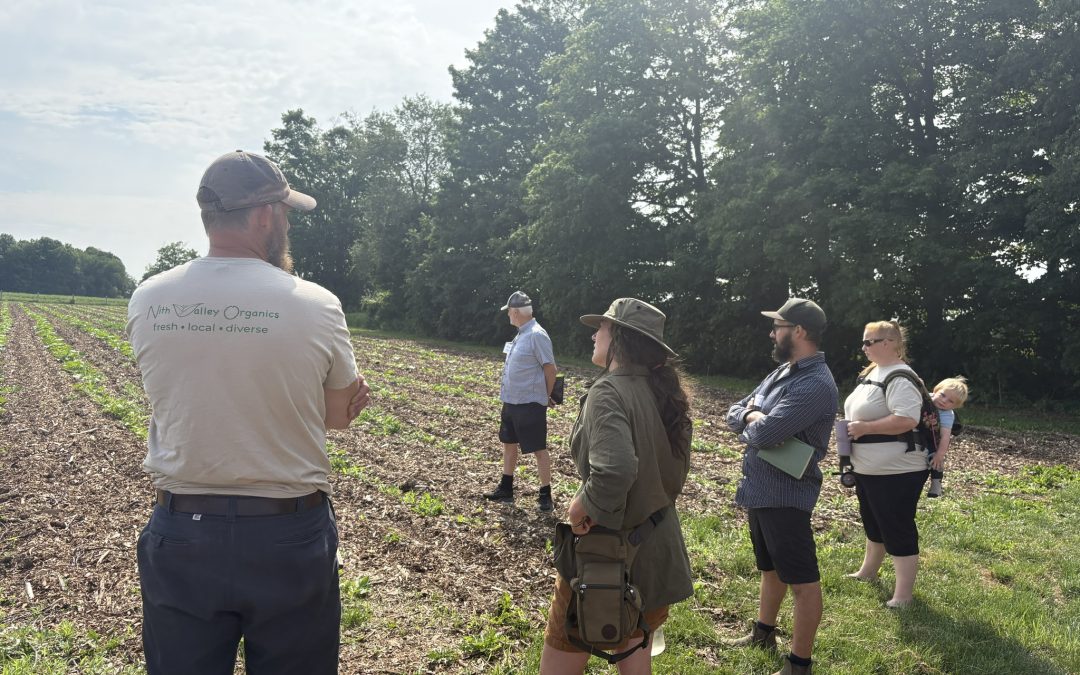
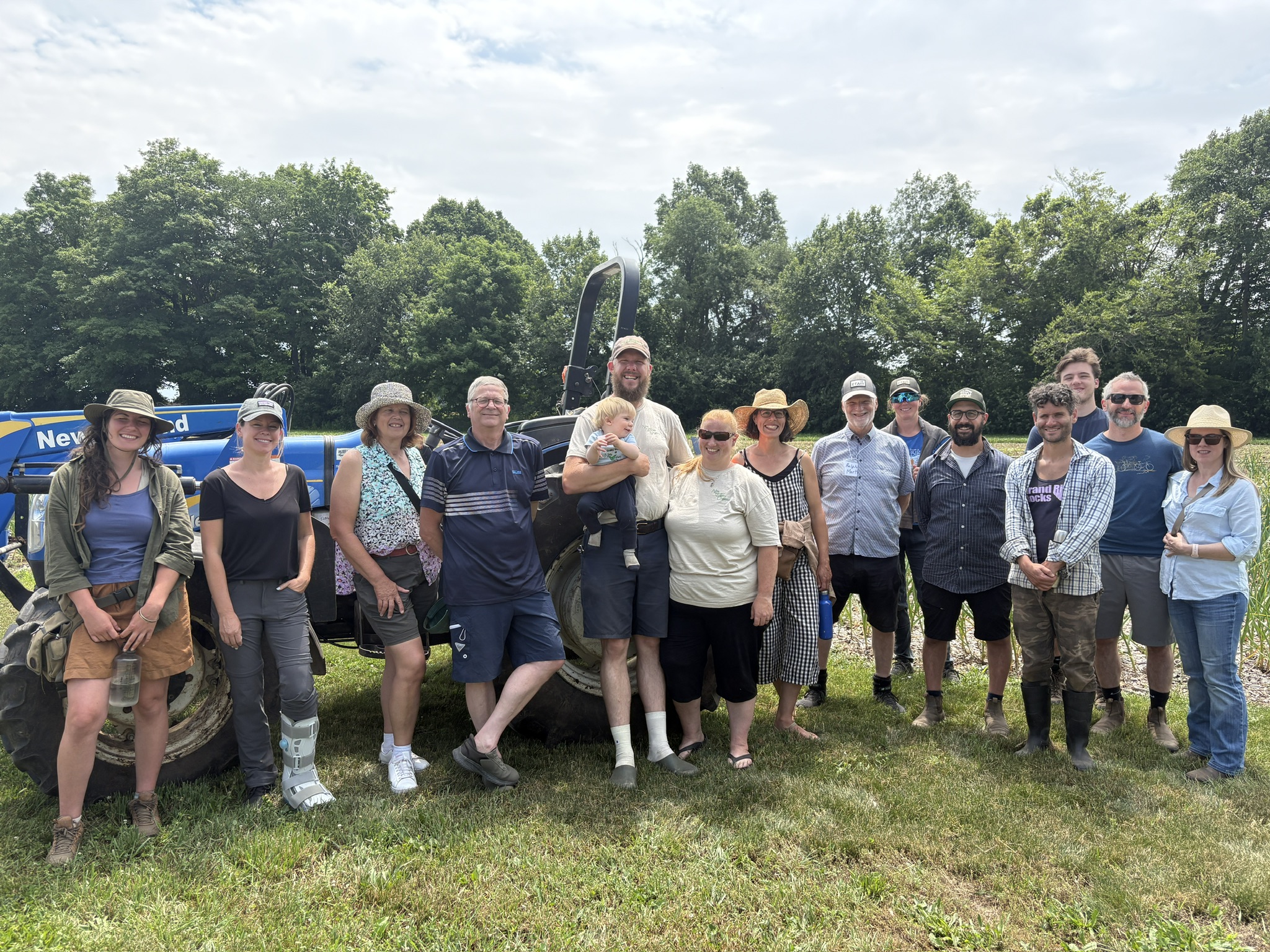
Wes Jackson, founder of the Land Institute, said “that for any parcel of land in human use there is an “eyes-to-acres ratio” that is right and is necessary to save it from destruction.” At Nith Valley Organics, the eyes of Nathan and Aleta Klassen assiduously scan their 75 acres with help from Nathan’s father, Victor, and up to 18 employees, depending on the season. Their young sons, David and Philip, often guided by Nathan’s mom, Sue, are in training, to strengthen the ‘ratio.’
The July 6 tour, like so many EFAO farm visits, or ‘polite investigations,’ provided hard nosed education with chuckles, on this well-tended land of six acres of organic vegetables, 1700 meat chickens, 150 turkeys and 50 ewes with 90 lambs. There are also greenhouses, 26 acres of rented-out land and 30 acres in hay and pasture, including chicken tractors.
Nathan is curious as sure as water is wet. With much appreciation for his proclivity to ask questions of himself and others, we learned about his farming journey. His active engagement in Farmer-Led Research projects of EFAO was evident in his smiles and grimaces, as he shared results with their realistic revelations, on his farm.
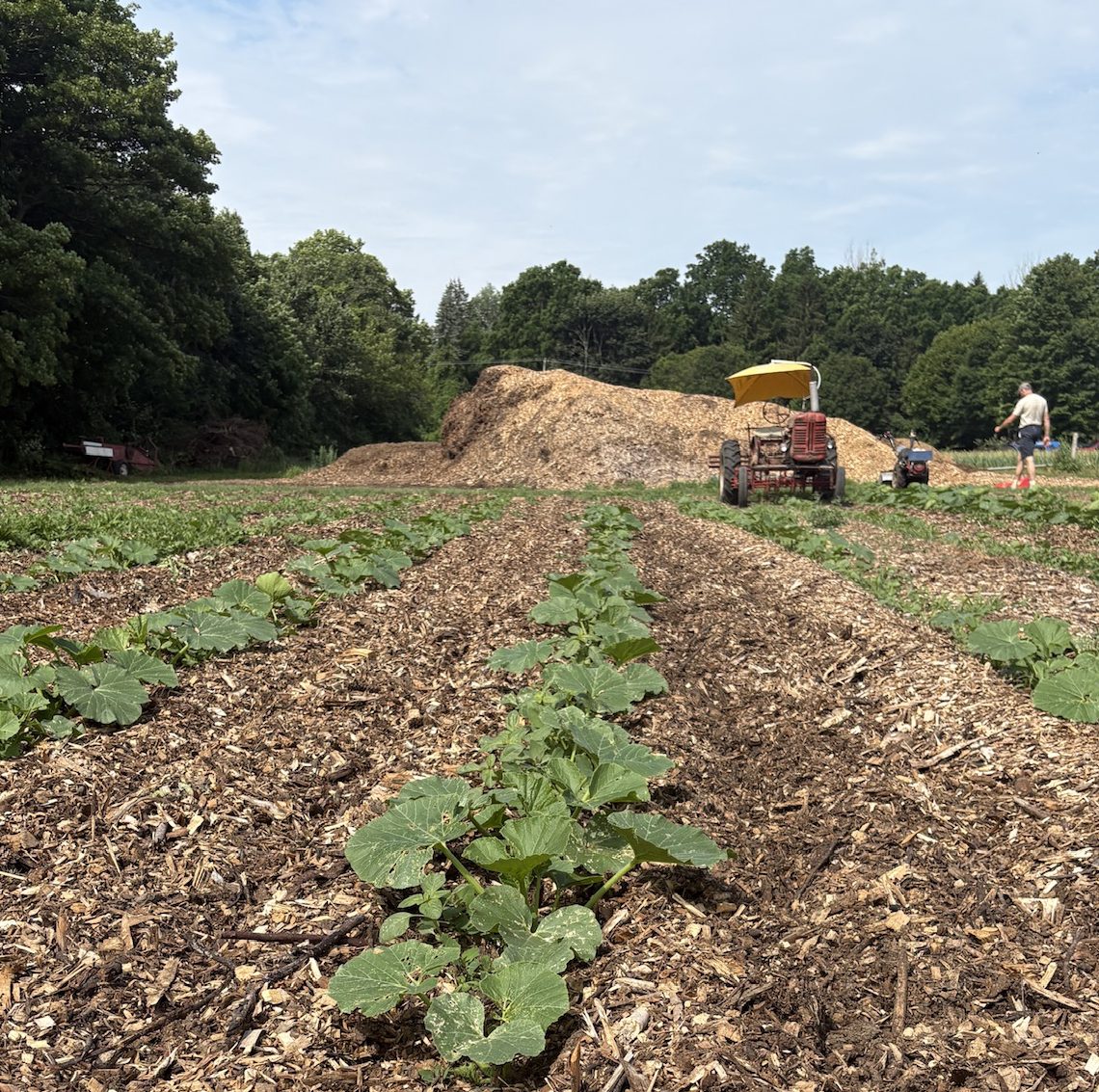 A hill of woodchips, initially mistaken for a silage pile at a distance, is the receiving, storage and weathering area for chips from a local tree service company. No money is exchanged, as they need a place to dispose them and the Klassens want carbon and weed control. “Given that some species don’t know the difference between being cut or chipped, weathering a few weeks before spreading decreases buckthorn, boxelder, and willow rooting in the field. We also try to avoid walnut chips, but a few aren’t a problem.”
Garlic is grown in a “3ish inch thick woodchip mulch” to control weeds and conserve moisture in the sandy soil. Every three spreader loads of chips are augmented by one spreader load of non-composted manure (imported beef manure with shavings and home-sourced sheep and poultry manure). His strategy reminds me of the nitrate depression curve in Figure 6.5 from Nyle Brady’s 8th edition of the Nature and Property of Soils, now at edition 15 and counting. It was the most used and reliable book of my ag career. Buy it! Yes, applying a high carbon source will reduce available soil nitrogen for a period but in the end more soil nitrate will be available. The C:N ratio is relatively constant and soil carbon increases will be followed by soil available nitrogen increases. I look forward to learning what the soil organic carbon levels are in Nathan’s fields.
“We irrigate frugally” with brass impact sprinklers at 60-foot spacings. Tape irrigation may use less water but took more time and effort to set up and maintain and violated their principle of simplicity. A dialogue between Nathan and Aleta revealed that now some fields are not exactly multiples of 60 feet and along with other adjustments led to a question about the tension between plans and flexibility. Nathan adroitly paraphrased Field Marshal Helmuth von Moltke, “No battle plan survives contact with the enemy.” While challenged by the random outcomes of weather, pests, competition etc., Nathan still plans, sees what happens and humbly adjusts as required.
In a response to a question about whether it is worth going to farmers’ markets, he admitted “it takes time to build up a continuous clientele, but when the lines persist, it’s worth it.” His highest business return on investment was for $300 he spent on a banner so customers could find him when moving indoors and back outside, as seasons changed at the Wychwood and Dufferin Grove farmers’ markets.
It’s impossible to touch on all the July 6 topics, but if you contact Nith Valley Organics and ask what you wonder about, Nathan will generously respond based on his healthy crops of experiences and ideas. Their recipe for success is a high “eyes-to-acres-ratio,” curious minds, receptive hearts and willing hands.
Ralph C. Martin grew up on his family farm in Wallenstein, ON. After earning a Ph.D. (Plant Science, McGill University, 1990) he taught at the Nova Scotia Agricultural College. In 2001, he founded the Organic Agriculture Centre of Canada and in 2011, was appointed as Professor, University of Guelph. In 2019, he retired and published the book, Food Security.