
By Angel Beyde
On August 1, 1834, the Slavery Abolition Act took effect, legally ending slavery across most of the British Empire, including the British North American colonies in present-day Canada.
Emancipation Day honours Black people who resisted enslavement and the generations who made freedom tangible through land, family, food, community and joy. Although Black communities have marked August 1 for nearly two centuries, Canada did not formally recognize Emancipation Day until 2021.
Celebrating freedom and continuing the struggle
Beginning in 1834, Black communities celebrated Emancipation Day with parades, communal meals, music, dancing, speeches, sporting events and fundraisers.
These gatherings honoured ancestors who had endured and resisted enslavement. They also strengthened community and created joyful public spaces where Black people could assert their freedom and belonging, confront racism and continue organizing for equality.
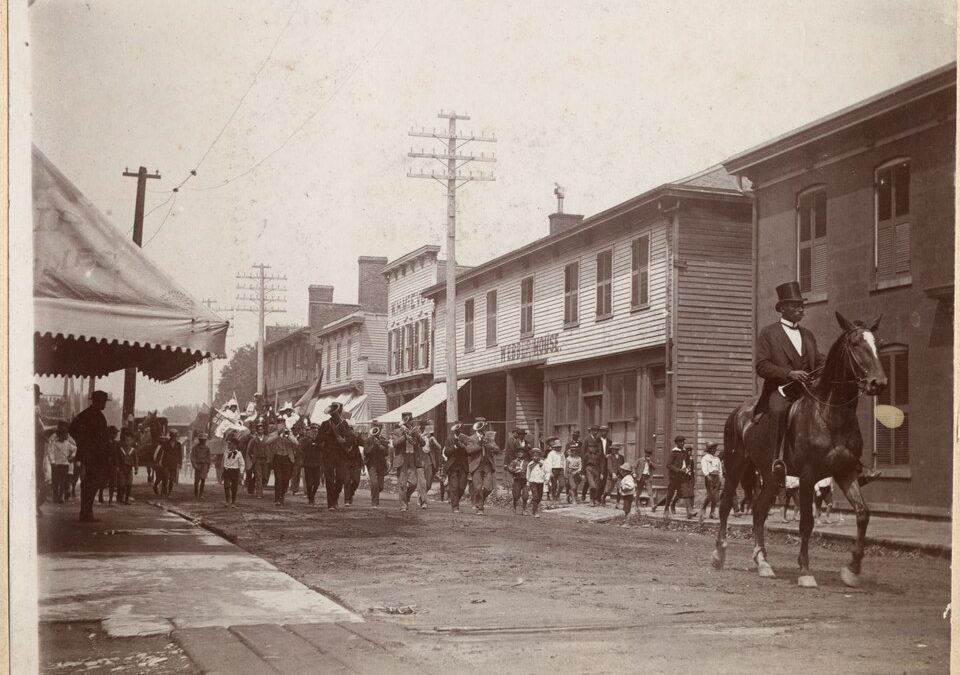
A photograph from Amherstburg in 1894 shows Moses Brantford Jr. leading an Emancipation Day parade through the town. Six decades after legal emancipation, Black communities were still gathering publicly to celebrate freedom while insisting on the rights and opportunities that emancipation had not ensured.
A picnic sustained across generations
One of Canada’s longest-running Emancipation traditions began in Owen Sound in 1862.
Owen Sound farmer and lay preacher Thomas Henry Miller helped unite the region’s Black community. Miller and other leaders of the British Methodist Episcopal Church organized an Emancipation Picnic to bring Black families from Grey and Simcoe counties together.
More than 160 years later, their descendants still gather at Harrison Park for food, music, family, remembrance and celebration.
The gatherings were beautiful, alive and joyful. Around 1898, the steamer Alderson carried picnickers to an Emancipation celebration at Presque Isle. After sharing an abundant dinner, children took turns on a flying trapeze and a Jubilee choir filled the gathering with song.
Thomas Henry Miller spoke movingly about emancipation, while elder James “Father” Henson imagined a future in which all races could live together peacefully. As the boat steamed away, the choir erupted into song.
Emancipation Day was always more than a solemn commemoration. It was also a day of pleasure, fellowship, imagination and collective hope.
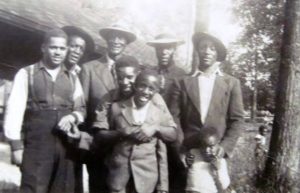
This photo is taken from the Owen Sound Emancipation Festival. “The photo was taken on Emancipation Day sometime in the forties. That is William (Bill) Miller in the white hat, along with his sons, a brother-in-law, and a grandson. I took this pic from my grandmother’s album. She is no longer with us & I am her oldest grandson. I am sure she would have been happy to share it.”
– Tony Kenneth Miller
Freedom rooted in land
For many Black families, the generations after 1834 brought new possibilities to acquire land, establish farms and build livelihoods. Legal emancipation did not provide land or erase racism, but Black families transformed any opportunities they could find into homes, food, businesses and community institutions.
Anthony Banks was born free in Colchester South in 1840, six years after legal emancipation. He eventually owned 116 acres. With his wife Susan and their children, they raised cattle and chickens, grew fruit, vegetables and tobacco, churned butter and produced flour. Their farm offers an inspiring example of what Black families built in the first generations after 1834: not only agricultural production, but lasting roots, family livelihood and community life.
Around 1849 or 1850, approximately 15 years after emancipation, William and Mary Ann Ghant walked much of the way from Toronto to Melancthon Township, roughly 100 km, in what is now Dufferin County.
They began with 50 acres, a log cabin and a patch of potatoes. Over time, the Ghant family secured 300 acres, grew oats, peas and barley, tapped approximately 250 maple trees and farmed with oxen.
Their story captures both the physical difficulty and the extraordinary possibility of establishing a farm in that period. From a cabin and a potato patch, the family built a substantial agricultural livelihood that endured across generations.
The limits of Emancipation
The achievements of families such as the Banks and Ghants are unfortunately not evidence that Black people received equal access to land, capital or opportunity after 1834.
Legal emancipation ended slavery. It did not dismantle anti-Black racism or ensure that Black families could acquire and retain farmland, access financing or build secure livelihoods on equal terms.
Those barriers have not disappeared. In interviews conducted for a 2019 study of Black food sovereignty in the Greater Toronto Area, Black farmers and food-system leaders described continuing obstacles to farmland, land ownership and start-up funding, the foundations needed to begin farming and build a viable farm business.
Black farmers’ success has always depended on far more than individual determination. It has also been shaped by discriminatory land systems, financing, public institutions and government decisions about who receives support and whose farming realities are recognized.
Carrying the work forward
Today, Emancipation Day holds joy, remembrance and unfinished work, together.
One part of that unfinished work is creating fairer pathways into farming. Agricultural policy shapes which supports are available, who qualifies for them and whether programs reflect the realities of new and historically underserved farmers.
This is why farmers’ knowledge must be present at the policy table. Listening directly to Black farmers, newcomer farmers and other new farmers can help governments and agricultural organizations build more inclusive pathways to start farming, remain on the land and develop viable livelihoods.
At EFAO’s July 15 field day at Lawoti Farms and Carabao Fields, participants toured under wildfire-smoke skies and named some of the pressures shaping small-scale farm viability: from extreme weather and labour challenges to the high cost of infrastructure, unstable land tenure and the lack of affordable childcare.
On August 10, EFAO will continue this conversation at SARN Farms and Brilliant Meadows. Through farm tours and facilitated discussion, participants will explore land access, farm establishment and the supports farmers need to build long-term viability.
Emancipation changed what was possible in law. Generations of Black farming families then turned freedom into land, food, livelihood, music, community and celebration, often despite enormous barriers.
Honouring that legacy means celebrating what Black farmers have built while continuing the work of creating agricultural systems in which more farmers can begin, stay and thrive.
Sources and further reading
Emancipation Day and the Owen Sound tradition
- Government of Canada, Emancipation Day — August 1.
- Parks Canada, Celebrations of Emancipation Day National Historic Event.
- Owen Sound Emancipation Festival: About Us, History and Resources, Recognizing Thomas Henry Miller and Presque Isle.
- CBC, On Emancipation Day, Celebrating a Family History That Stretches to the Underground Railroad, 2017.
- Nancy M. Lee, “My Journey: Finding My Grey County Roots”, Northern Terminus: The African Canadian History Journal, Vol. 10, 2013. Grey Roots Museum & Archives.
Black farming families and agricultural settlements
- Amherstburg Freedom Museum, The Banks Family, including Part 2 and Part 4 of The Law-Abiding and Law-Enforcing Banks Family.
- Stephen Sawden, with an appendix compiled by Peter Meyler, “The William Ghant Family: Pioneers of Melancthon Township”, Northern Terminus, Vol. 7, 2010. Grey Roots Museum & Archives.
- Ontario Heritage Trust, Josiah Henson Museum of African-Canadian History, including the history of farming, education and cooperative enterprise at the Dawn Settlement.
- Buxton National Historic Site & Museum, The Museum Complex and History of the Elgin Settlement.
- Ontario Heritage Trust, Puce River Black Community, on the Refugee Home Society and the establishment of Black family farms in Essex County.
- The Black Past in Guelph, Queen’s Bush resources and histories, including Black settlement, farming, land policy and dispossession in Wellington and Waterloo counties.
Archives and contemporary food sovereignty
- Archives of Ontario, Black Histories in Ontario: The Alvin D. McCurdy Collection, an extensive collection of photographs, family records and community histories from southwestern Ontario.
- Hansel Igbavboa and Sheldomar Elliot, The Challenge of Food Sovereignty for Black Farmers in the Greater Toronto Area, Future Farmers / Map the System, 2019. See also the Toronto Metropolitan University project overview.
We gratefully acknowledge the descendants, historians, museums, archives and community organizations preserving and sharing these histories.